
Historical Treasure Terre Haute’s Second City Park Has Seen Many Interesting Changes Over the Years
By Tamie Dehler
City Park, Steeg Park and Gilbert Park are three different names given over time to one modest patch of ground on east Wabash Avenue that became Terre Haute’s second city park.
In 1903, the park made its debut amid controversy. Terre Haute Mayor Henry Steeg was originally opposed to the purchase of the land. However, he reportedly yielded under pressure when the Terre Haute City Council finally pulled its opposition to a salary grab attempted by city officials. The Council unanimously adopted a $25,000 bond to purchase the land and raised the salaries of the mayor and other officials. Steeg then voted in favor of the new park but was sometimes denigrated in the press for what the project’s detractors called “Hobo Park.” Initially, the new park was called City Park, but the Council renamed it after Mayor Steeg in 1911, following his death.
Steeg Park had some grand plans and looked quite different in 1911. Its centerpiece was a fountain facing Wabash Avenue encircled by an oval drive connecting to Gilbert Avenue on its south border. Promenades crisscrossed the lawn. The park was enlarged twice–first, on the east side to 15th Street, and next, to the south, encompassing the location of the old Gilbert family homestead. Renowned architect George Kessler provided updates in 1920 to the park’s blueprint, and Steeg park became part of his unrealized plan to encircle Terre Haute with a system of parks and greenways.
In Steeg Park’s long history, there are a few unusual and noteworthy events that stand out. In 1920, a matron was hired to supervise playground safety for 8 hours, daily. The most dangerous pieces of playground equipment were then taken down each night. Then, in 1925, one of the largest labor demonstrations in Terre Haute history paraded through the city to Steeg Park, where Eugene V. Debs addressed the crowd. The year 1926 saw two Florida alligators being gifted to the City of Terre Haute and placed in the Steeg Park fountain. Within a month, one had died. A third alligator was donated by Viquesney’s Printing Company to replace the dead one. In 1931, Terre Haute Mayor Wood Posey considered having an armory constructed on the east end of the park, but plans never materialized. And in 1943, the American Legion removed a historic World War I cannon from Steeg Park and donated it to the local scrap metal collection center for wartime recycling.
By 1965, Steeg Park was looking run-down, though it was still a popular rest stop for travelers on U.S. 40. In May 1965 alone, 700 cars with out-of-state license plates had been observed stopping there. Noting its popularity, the Scented Garden Committee organized to beautify the park. Holding fundraisers and cooperating with the city, the volunteers oversaw the addition of new lights, improved walkways, removal of dead trees, a drinking fountain, new picnic tables, the planting of more flowers and trees, and a plan to upgrade the fountain area by adding greenery, cobblestones, and colored lights. The City then changed Steeg Park’s name to Gilbert Park in 1966. Two years later, the improvements made to the park received praise from First Lady of the United States Lady Bird Johnson, a successful crusader for the beautification of the nation’s cities and highways.
This is the history of Steeg Park, pictured on the postcard above. After its renaming to Gilbert Park in 1966, there is another history that lives on today. As space is limited, this “second history” of the park will have to be continued at a later date.
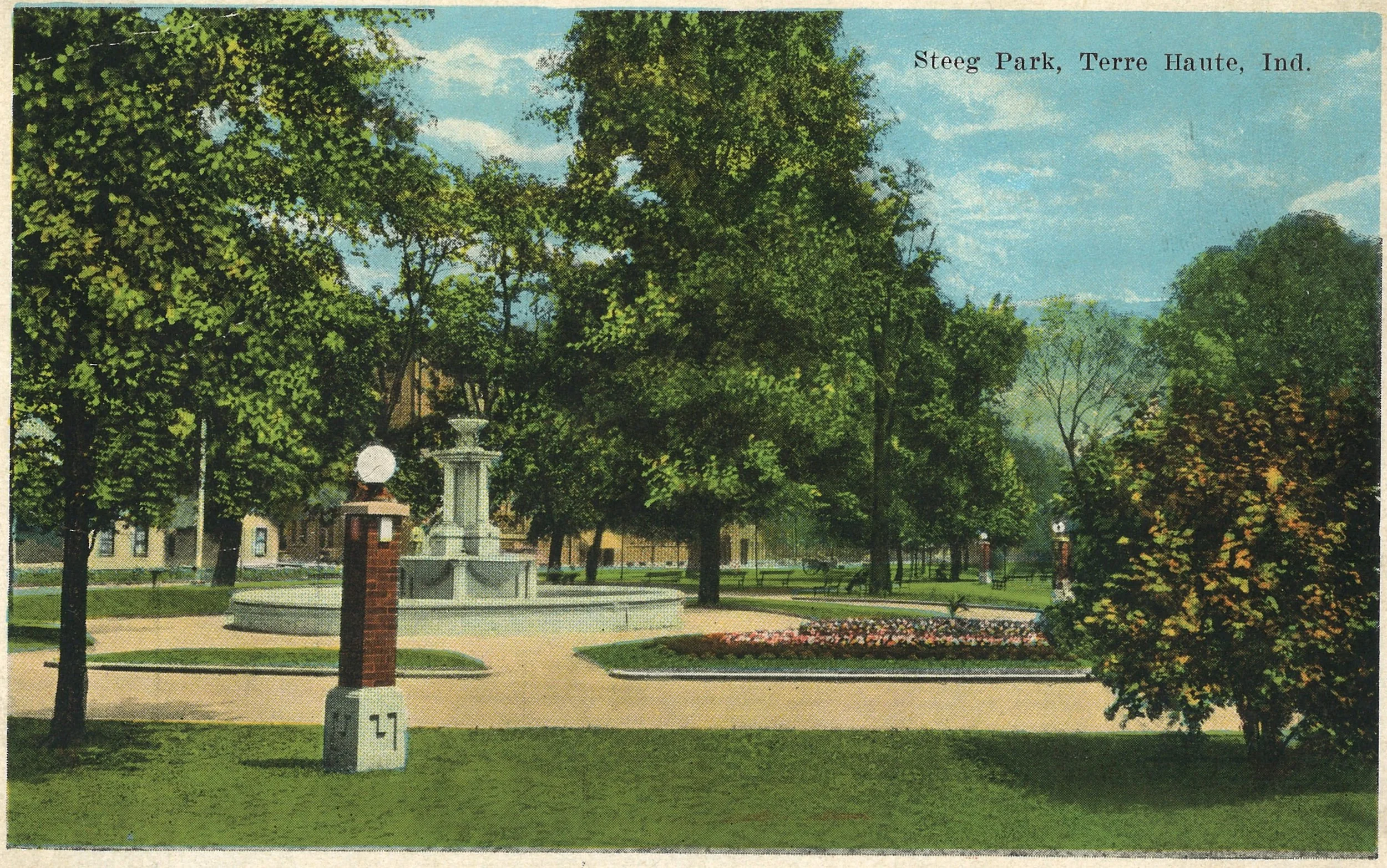
Steeg Park Postcard- Vigo County History Center Archives
